What Is EFT Tapping? A Clinician’s Guide to Emotional Freedom Techniques
Jun 03, 2026
Read Time: 11 Minutes
Written By: The TTI Team
Here is a scenario you might recognize. A colleague mentions tapping in passing. You nod, file it somewhere in the mental folder marked “look into this eventually,” and move on with your day. Then a client brings it up. Then it shows up in training. Then you see a headline about a new clinical trial and you think, fine, what actually is this?
The honest answer is more interesting than the way it usually gets explained. EFT tapping, or Emotional Freedom Techniques, tends to get introduced either through wellness content full of energy field language that makes evidence-based clinicians cringe, or through breathless testimonials that claim it cures everything. Neither version is particularly useful if you are trying to figure out whether this belongs in your clinical toolkit.
So let’s start from scratch. This is a clinician’s guide to what EFT tapping actually is, where it came from, what the peer-reviewed research says, and how it compares to the approaches you already know. By the end, you should have a clear enough picture to make your own call.
First, Let’s Sort Out the EFT Acronym Problem
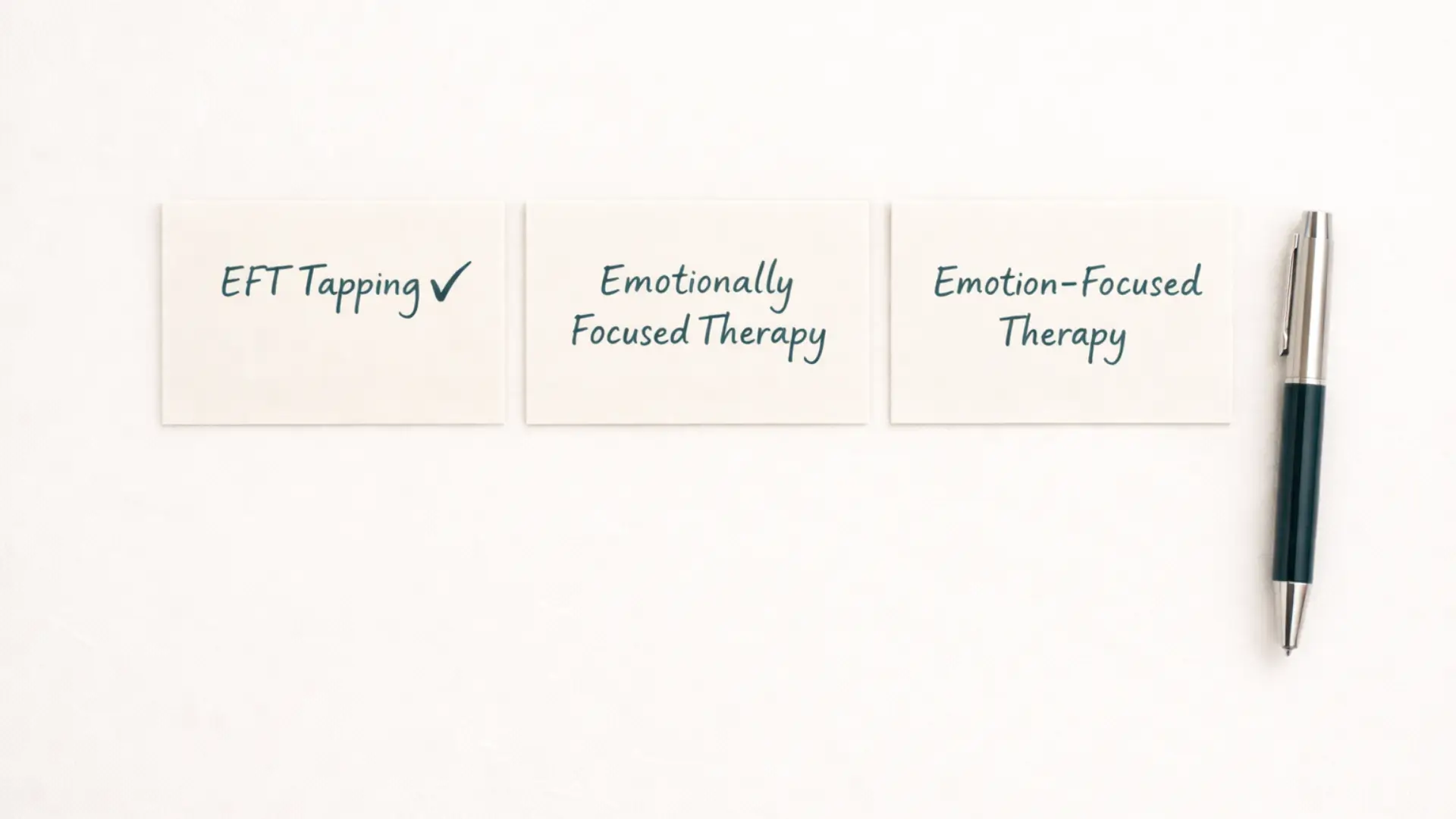
What is EFT tapping and how is it different from Emotionally Focused Therapy? This is genuinely one of the most common sources of confusion in the mental health field, and for good reason. “EFT” is an acronym used for three completely different approaches that happen to share initials.
Here is the quick breakdown:
- Emotional Freedom Techniques (EFT tapping): a body-based, exposure-informed intervention that combines acupressure with focused attention on distressing material. This is what this post is about.
- Emotionally Focused Therapy: Sue Johnson’s evidence-based couples therapy model, grounded in attachment theory. Entirely different field, different population, different mechanism.
- Emotion-Focused Therapy: Les Greenberg’s individual therapy approach focused on emotional processing and transformation. Also unrelated to tapping.
All three appear in search results when you type “EFT therapy.” All three get cited in mental health conversations without the full name attached. If you’ve ever read something about EFT that seemed to be describing couples work and ended up confused, this is why. From here on, EFT means Emotional Freedom Techniques only.
Where EFT Tapping Comes From: A Brief, Honest History
The origin story of EFT is worth knowing because it explains both why clinicians got skeptical and why that skepticism may now be worth revisiting.
In the early 1980s, a clinical psychologist named Roger Callahan developed Thought Field Therapy (TFT), a system of tapping on acupressure points drawn from traditional Chinese medicine. Callahan’s framework was heavily influenced by the energy meridian model, which proposed that psychological distress stemmed from disruptions in the body’s energy field. That framing put TFT firmly in the “alternative” category for most mainstream clinicians.
In the early 1990s, Gary Craig, who had trained under Callahan, took TFT’s complicated algorithms and simplified them. He created a standardized sequence, one set of tapping points that could be used across all problems, and called it Emotional Freedom Techniques. His version was more accessible, but the energy language stayed, and with it, the skepticism.
What changed over the following decades was the research. The manualized form of EFT now used in clinical trials, called Clinical EFT, was developed specifically to meet the standards required for evidence-based designation. Current research no longer attempts to explain EFT through subtle energy theory. It focuses on measurable neurobiological mechanisms: limbic system changes, cortisol modulation, and memory reconsolidation. The framing shifted from energy fields to neuroscience, and the evidence base followed.
What Is EFT Tapping? The Clinical Definition
At its core, EFT tapping is a body-based psychological intervention that combines three elements simultaneously:
- Somatic stimulation: tapping with the fingertips on nine specific acupressure points on the face, hand, and upper body
- Focused attention: consciously holding a specific distressing issue, feeling, or memory in mind during the tapping
- A self-acceptance statement: a spoken phrase that pairs acknowledgment of the problem with an affirmation of self-acceptance
The self-acceptance statement, called the set-up statement, follows a consistent structure: “Even though [specific problem or feeling], I deeply and completely accept myself.” The client repeats this while tapping the karate chop point on the side of the hand, then moves through the remaining eight points with a shorter reminder phrase. Before and after each round, the client rates their distress on a Subjective Units of Distress (SUD) scale from 0 to 10. The process continues until the distress rating comes down to a manageable level.
Here is what is clinically important about that structure. EFT is not a relaxation technique. The client is not being asked to avoid the distressing material or breathe through it from a distance. They are making direct contact with the problem, holding it in mind, while the tapping simultaneously engages the body’s stress response system in a way that interrupts that response. It is, in clinical terms, an exposure-based intervention with a somatic component. That is a very different thing from a wellness tapping video.
How Does EFT Tapping Work in the Brain?
This is the question that matters most for skeptical clinicians, and it now has a more substantive answer than it did ten years ago.
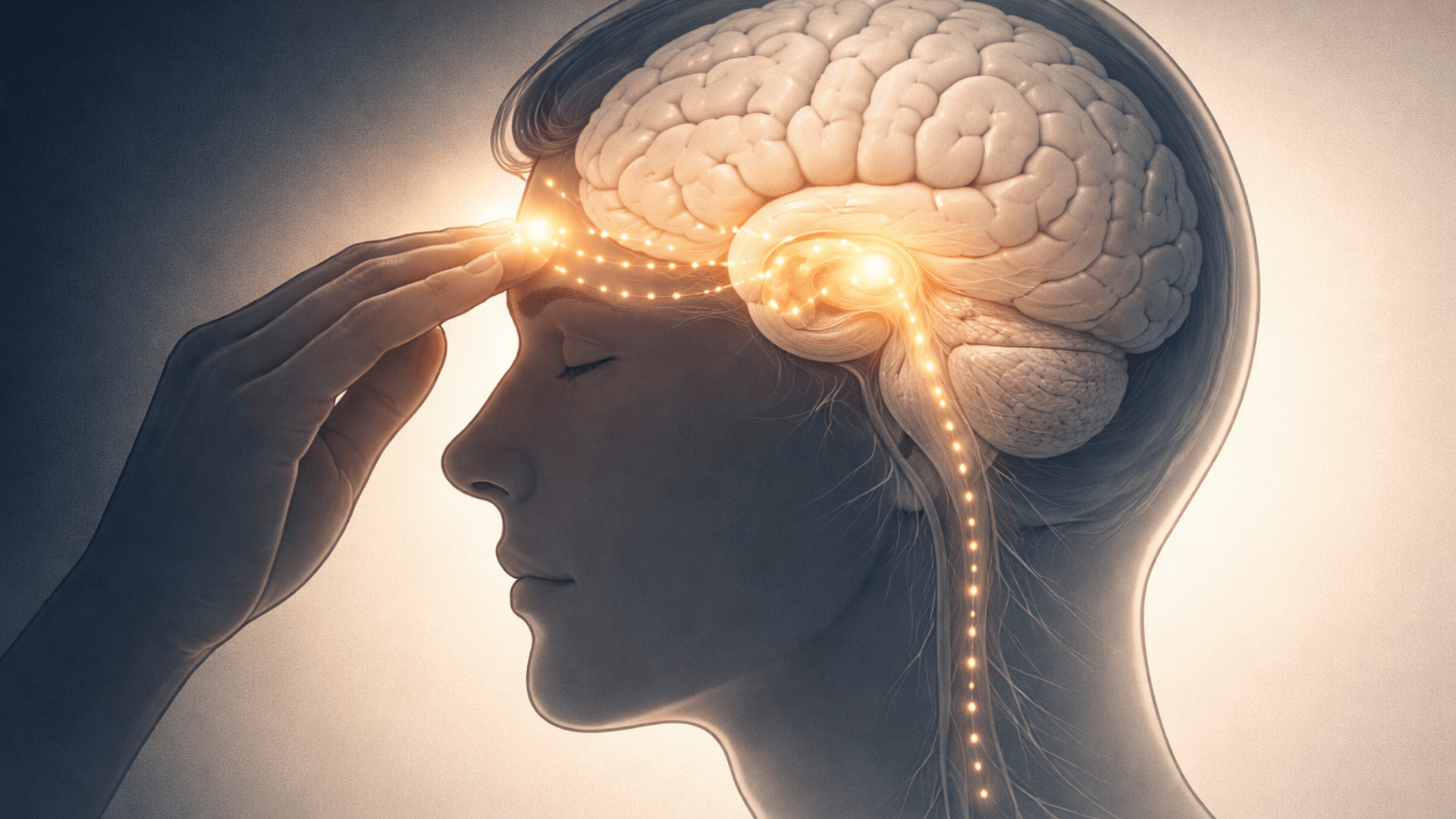
A 2025 mechanisms review by David Feinstein, published in Frontiers in Psychology, synthesizes two decades of physiological research into what happens during a tapping session. The short version: tapping appears to generate electrochemical signals through the skin that travel to the brain and downregulate activity in the limbic system, particularly the amygdala. Harvard Medical School’s decade-long investigation into acupoint stimulation using fMRI showed that stimulating these points produced rapid reductions in amygdala arousal, sometimes within seconds. This is consistent with what clients report experientially: a noticeable shift in the intensity of the distress while the material is still present.
On the hormonal side, a randomized controlled trial by Church et al. measured cortisol levels before and after a single session of EFT, talk therapy, or no treatment. The EFT group showed an average cortisol reduction of 24%. The talk therapy and no-treatment groups showed no significant change. Cortisol is the primary stress hormone. A 24% drop in a single session, compared to no change in therapy as usual, is a meaningful finding.
The most clinically significant mechanism may be memory reconsolidation. Each time a memory is recalled, it enters a brief window of neurological lability where it can be updated before being stored again. If a client recalls a distressing memory while simultaneously in a state of physiological calm created by the tapping, the brain registers a prediction error: it expected distress and found calm instead. That mismatch is the condition memory reconsolidation theory says is required to update the emotional charge of a memory. The tapping is not suppressing the memory. It is creating the neurological conditions for the memory’s emotional associations to be rewritten.
You can read more about the nervous system science underlying these mechanisms in TTI’s primer on polyvagal theory, which helps frame why body-based regulation approaches like EFT can produce changes that talk alone often cannot.
What the Clinical Trials Actually Show: EFT Tapping Evidence
The research base for EFT tapping has grown substantially over the past two decades. Here is an honest summary.
More than 200 peer-reviewed clinical trials have been published on Clinical EFT. A 2022 systematic review identified 56 randomized controlled trials and concluded that Clinical EFT meets APA Division 12 criteria as an evidence-based practice for anxiety, depression, phobias, and PTSD. Five meta-analyses exist across these conditions. Effect sizes are large: PTSD (d = 2.96), anxiety (d = 1.23), depression (d = 1.31). These numbers exceed those typically reported for pharmacological interventions and for conventional psychotherapy in comparable populations.
The 2023 updated systematic review and meta-analysis for PTSD drew on trials covering veterans, sexual violence survivors, motor accident survivors, disaster survivors, adolescents, and genocide survivors across multiple countries. Ninety-six percent of published studies report results in EFT’s favor. The dropout rate in PTSD trials is lower than in many established treatments, which suggests clients are not finding the experience intolerable.
Is there remaining debate? Yes. Some researchers argue that the active ingredient in EFT may be the cognitive and exposure elements rather than the acupressure stimulation specifically. Dismantling studies have produced mixed results on this question. The response from EFT researchers is that even if the acupressure component’s unique contribution is still being quantified, the clinical outcomes are consistent and replicable, and that matters for clinicians who need to make decisions about what to do in a room with a client.
The US Veterans Administration designated EFT as “generally safe” in 2017. Zero adverse events have been reported across 2,000+ research participants. That safety profile, combined with the effect size data, is what makes this worth taking seriously.
EFT Tapping vs. EMDR, Somatic Therapy, and CBT: What’s the Difference?
If you already work with trauma clients, you have a framework. Here is how EFT fits alongside the approaches you probably already know.
EFT Tapping vs. EMDR
Is EFT tapping the same as EMDR? No, but they share more than most people realize. Both are exposure-based. Both work through memory reconsolidation rather than avoidance. Neither requires clients to fully narrate the traumatic event. Both have strong randomized controlled trial support for PTSD.
The differences are in mechanism and structure. EMDR uses bilateral stimulation, typically eye movements, across a formal eight-phase protocol. EFT uses acupoint tapping and operates across two clinical modes: a regulation mode and a trauma processing mode. A 2011 controlled trial, the first ever direct comparison of the two approaches for PTSD, found similar effect sizes in an equal number of sessions. They are different tools that seem to reach a similar destination through different routes.
For EMDR-trained clinicians, EFT is not a replacement. It is a complement, particularly useful in Phase 1 regulation work, with clients who are not yet stable enough for full reprocessing, or as a self-help skill clients can use between sessions independently.
EFT Tapping vs. Somatic Therapy
Somatic approaches focus on the body’s sensations and stress response, typically without a strong cognitive component. EFT adds the set-up statement, which introduces cognitive reframing and explicit exposure into the same intervention. The somatic stimulation and the cognitive elements happen simultaneously rather than sequentially. For clients who need both regulation and cognitive engagement in the same session, that combination can be more efficient than alternating between separate approaches.
EFT Tapping vs. CBT and Exposure
Standard exposure therapy involves sustained contact with feared material until the distress response habituates. The risk with complex trauma presentations is flooding. EFT builds a regulatory buffer into the exposure itself: the tapping is running continuously while the client engages the material, which appears to reduce the risk of overwhelm during direct contact with traumatic content. It is not that EFT bypasses the exposure. It is that it changes what the exposure feels like while it is happening.
For a deeper look at how somatic and body-based approaches integrate with trauma processing, TTI’s clinical conversation with Dr. Robert Schwarz covers how EFT specifically supports regulation as a foundation for deeper trauma work.
What Is EFT Used for Clinically? The Evidence by Condition
The strongest evidence base covers four main areas.
- PTSD and trauma: the largest body of research, covering both single-incident and complex trauma presentations. Studied extensively with veterans, disaster survivors, and genocide survivors. Effective in individual and group formats, including via telehealth.
- Anxiety disorders: including generalized anxiety, phobias, and test anxiety. Meta-analyses show a large treatment effect size.
- Depression: a 2024 meta-analysis of 18 randomized controlled trials published in the Journal of Clinical Medicine found an overall effect size of 1.268, with group delivery and moderate-severity presentations showing particularly strong results.
- Chronic pain: a fMRI study published in Complementary Therapies in Clinical Practice found significant reductions in pain severity, anxiety, and depression alongside measurable changes in neural connectivity after a six-week EFT intervention.
EFT has also been studied in healthcare worker burnout, with a review published in PMC noting its accessibility, absence of side effects, and suitability for self-administration as particular advantages in high-stress professional populations.
What EFT is not: it is not a replacement for psychiatric care, crisis intervention, or specialized trauma protocols for high-complexity presentations. Clinical judgment about when and with whom to use it is still required, as with any approach.
The PTSD clinical guidelines for EFT include a stepped-care framework specifically designed to guide clinicians through decisions about treatment intensity for more complex cases.
Can Any Licensed Therapist Use EFT Tapping with Clients?
Can any licensed therapist use EFT tapping with clients? In most cases, yes, after appropriate training. EFT tapping does not require a separate licensure pathway for licensed mental health professionals. What it does require is clinical competence, and that distinction matters.
The critical difference is between wellness or self-help EFT, which is widely available online and designed for general use, and Clinical EFT, which is the manualized, research-validated form used in the trials described throughout this post. Clinical EFT is not something you pick up from a YouTube playlist. It requires understanding the full protocol, the clinical decision-making involved in moving between regulation and processing modes, and the specific techniques designed for trauma populations.
The tearless trauma technique, the tell the story technique, and the personal peace procedure each require clinical skill and judgment to apply safely. You are not just guiding a client through a tapping sequence. You are making moment-to-moment decisions about pacing, titration, and whether the client is inside or outside their window of tolerance.
The question to ask is not “do I have a certification?” but rather “have I learned this from someone with genuine clinical depth and a real grounding in trauma treatment?” A weekend wellness workshop and a comprehensive clinical training are not the same thing, even if both award a certificate at the end.
Ready to Learn Clinical EFT Tapping for Trauma Work?
If this has shifted your thinking from “interesting, maybe someday” to “I want to learn how to actually do this,” here is a place to start.
EFT Tapping Training for Trauma Therapists is a live, full-day training with Dr. Robert Schwarz, PsyD, DCEP, a licensed psychologist with 40 years of clinical experience and 16 years as Executive Director of the Association for Comprehensive Energy Psychology. Dr. Schwarz is one of the most credentialed and experienced EFT trainers in the field, and he teaches it inside a phase-oriented, trauma-informed clinical framework rather than as a standalone technique.
- Thursday, July 16, 2026 | 10:00 am – 5:30 pm Central | Live online
- 6 CEs | ASWB, NBCC
- Open to all licensed clinicians. No prior EFT experience required.
You will leave with the full EFT protocol, the tearless trauma and tell the story techniques, the personal peace procedure, and a clear clinical map for when and how to use each one.
Learn more and register here
References
Church, D., Stapleton, P., Vasudevan, A., & O’Keefe, T. (2022). Clinical EFT as an evidence-based practice for the treatment of psychological and physiological conditions: A systematic review. Frontiers in Psychology, 13, Article 951451. https://doi.org/10.3389/fpsyg.2022.951451
Church, D., & Feinstein, D. (2017). Guidelines for the treatment of PTSD using Clinical EFT (Emotional Freedom Techniques). Healthcare, 5(4), Article 49. https://doi.org/10.3390/healthcare5040049
Clond, M., & Sebastian, B. (2023). Emotional freedom techniques for treating post-traumatic stress disorder: An updated systematic review and meta-analysis. Frontiers in Psychology, 14, Article 1195286. https://doi.org/10.3389/fpsyg.2023.1195286
Feinstein, D. (2025). How tapping works: Physiological and psychological mechanisms in energy psychology treatments. Frontiers in Psychology, 16, Article 1660375. https://doi.org/10.3389/fpsyg.2025.1660375
Karatzias, T., Power, K., Brown, K., McGoldrick, T., Begum, M., Young, J., Loughran, P., Chouliara, Z., & Adams, S. (2011). A controlled comparison of the effectiveness and efficiency of two psychological therapies for posttraumatic stress disorder: Eye movement desensitization and reprocessing vs. emotional freedom techniques. Journal of Nervous and Mental Disease, 199(6), 372–378. https://doi.org/10.1097/NMD.0b013e31821cd262
Lin, Y., Fang, S., Li, Y., & Zhang, Y. (2024). The effectiveness of emotional freedom techniques for depressive symptoms: A meta-analysis. Journal of Clinical Medicine, 13(21), Article 6481. https://doi.org/10.3390/jcm13216481
Schwarz, R. (2018). Energy psychology, Polyvagal Theory, and the treatment of trauma. In S. W. Porges & D. Dana (Eds.), Clinical applications of the polyvagal theory: The emergence of polyvagal-informed therapies (pp. 270–284). W. W. Norton & Company.
Stapleton, P., Baumann, O., O’Keefe, T., & Bhopti, S. (2022). Neural changes after Emotional Freedom Techniques treatment for chronic pain sufferers. Complementary Therapies in Clinical Practice, 49, Article 101653. https://doi.org/10.1016/j.ctcp.2022.101653
Stout-Shaffer, S., & Balaban, A. (2023). Emotional freedom technique: Tap to relieve stress and burnout. International Journal of Childbirth Education. https://pmc.ncbi.nlm.nih.gov/articles/PMC9840127/
Stay connected with fun info, news, promotions and updates!
Join our mailing list to receive the latest news and updates from our team.
Don't worry, your information will not be shared.